Wednesday, April 29, 2026

April 2026 Reads

April 2026 Reads

April came she did, but for all the excited talk of a book frenzy in last month's post, it turned out to be quite quiet in terms of actual reading. Book intake was reduced significantly by various excuses factors, such as an early Easter holiday, along with literal piles of marking at school, and Spring messing with the daylight settings. All of which made for scant opportunities to get my nose into a volume. 

However, there was the much-anticipated pleasure of a trip to Alnwick, where Barter Books was quite the experience, and multiple charity shops yielding some great finds... and I did get one or two things read.

The List

The Hero of This Book - Elizabeth McCracken
Listen, Little Man! - Wilhelm Reich 

The Hero of This Book - Elizabeth McCracken

Another book that enjoys tampering with the lines between fiction and true story (if they're even still things) - uncertainty lurking behind every travelogue sequence or autobiographical recollection. It's a sort of fictional sort of memoir, dealing with grief and celebration, mapping closely processes of distancing and dislocation. 

I say "sort of": from the playful title and the dedication page facsimile image of an inscribed volume by the author, and prefatory quotation from a different Elizabeth, The Hero of This Book places itself in sometimes awkwardly self-conscious positions of assertion and denial about reality, the nebulous truths and self-serving nature of autobiography, relationships between humans, our understanding of ourselves and our closest relatives in times of loss, grief and mourning, our situations and associations, the acts of writing. 

Which makes it all "true" in some of the deepest senses of that concept, while also being an avowedly fictional construction. So, sort of; feather of lead and all that. 

We (your book-reading narrator, and their spouse) recently experienced the death of a mother — December 2025 — and this book popped up on an endcap in the library with uncanny timing. It resonated strongly because it didn't pander to traditional tropes of loss and recall, a text spikily independent, like "the mother" (Natalie), in a way of which the mother (Johanna) might have approved.


Listen, Little Man! - Wilhelm Reich

Having read The Mass Psychology of Fascism some time back and got a lot out of it, I was pleased to pick up this curio in the splendidly-appointed vintage shop and haunt for antiquaries The Beehive in Alnwick. 

Reich was a fascinating and complex character, an outlier in science, often stereotyped as a crank, although one with the kinds of ideas that seem wayward but influential in various fields. 

This book-length essay sees the former psychoanalyst frequently bitter in tone. It was written just after World War Two and essentially is Reich saying "Look, I tried to help you guys out but, I dunno, I'm not sure I have it in me." The idea is that the Little Man, the mass of humanity, is in the shit because they keep doing stuff like saying they deplore fascism but then diving in to the next flavour of oppression without a qualm. 

"Every once in a while you stick your head out of the morass to yell, Heil!" 

Reich uses the book to air some personal-sounding grievances as well, which makes it less effective in places than it might have been. According to the blurb, the essay is "pungent" and was "not intended for general publication". There is much that makes one say, "Well, quite so" to this info. There's a lot in the book that has weight, though, and chimes quite stridently with world politics in the big '26. Like a lot of wayward, "difficult" thinkers, if one can filter the foibles, the grains of truth are often worth the wade through the morass.   


What We Did On Our Morning Out At Barter Books 

Barter Books was a delight in many respects - housed in an old railway station, we arrived like passengers alighting in a land of wonder (etc etc), enjoying the model railway, idiosyncratic shelving, tasty coffee, and even the supremely impatient member of staff that patronised me through the "barter" aspect, much to the amusement of my teenage daughter. Still, indifferent customer service is an essential component of all true book shops, and I was asking kind of excitably dim questions in my urgency to establish a lifelong friendship with the place. 

I don't know if I quite managed that, but it was pretty good. Once my happy place surge of enthusiasm had abated, we managed to get fairly fair prices for the 10 volumes we brought in, which gave us some money to spend on refreshing the reading piles, then we wandered the aisles for a couple of contented hours nosing through the spines. 


Ye swag^

Next day, I had a solo wander round the charity shops and found this Peter Ackroyd biog of Old Toilets in (I think) the RSPCA shop - for £1! Awesome.  I also felt a genuine old-school second-hand bookshop connection with the Lions Bookshop down the road, where everything was alphabetised properly, in clearly defined sections, and also about £1 for everything as well. My kind of town, Alnwick! 

Next month - "Whatever Happened to the Stack Reduction Plan?"   


Tuesday, March 31, 2026

March 2026 Reads

 March 2026 Reads

For March I started out with a mind to read a couple of novels and something political, which I nearly managed... but The Difference Engine slowed me down a bit more than anticipated, and then I had most of a week away without many opportunities to read, and then the next thing you know the clocks have gone forward, spring is sprung and April knocks on the door once more. 

Still, an interesting selection... 

The List

The Difference Engine - William Gibson & Bruce Sterling

The Spike Milligan Letters (ed. Norma Farnes) 

The Agricola and The Germania - Tacitus

The Way I See It - Cliff Richard 

What is Anarchism?- Donald Rooum and Others

The Books 

The Difference Engine - William Gibson & Bruce Sterling

 From 1990, this is considered a foundational text of steampunk, based in a world where we see the earlier adoption of computation devices, particularly by France and the UK.  
There is an unwieldy globetrotting plot involving various characters in search of a McGuffinish set of data cards, coveted by "clackers" (hip retro-lingo for hackers) for bringing Babbage machines (ye "difference engine") grinding to a halt... in much the same way as a lengthy Untouchables-inflected middle section where a gang of four Imperial likely lads takes on a band of anarchists in an East London dockside warehouse (an idea surprisingly untouched by Guy Ritchie at time of writing) does for the novel. 
 Although touching on details of equipment (the "camphorated cellulose" data cards, steam powered racing cars, kinotype devices for projecting images, etc) Gibson and Sterling don't lavish attention on machine-gun wielding Zeppelins piloted by people with flying goggles and leather kit, as later iterations of the genre tend to; they do seem to enjoy getting into period costume and romping about a mostly-convincingly-rendered London, and the focus is the people and their intrigues within a world that is being shaped by an emerging technology, which is of course far more interesting in many respects. Still, though, with a closing section rammed with excellent but tangential riffs, I felt more a sense of loose endings and hinted-at story lines wafted past.  


The Spike Milligan Letters (ed. Norma Farnes) 

 Dear Mark
It has come to my attention beyond the grave that you found a slightly water-damaged copy of a small collection of my correspondence, on a supermarket charity table. Look on my works, ye mighty, and despair!
Yes, yes - some of them are funny, some haven't aged well, some seem to be barely-disguised cries for help that should have stayed in Norma Farnes’ filing cabinets… but that's not why I'm writing. 
Listen, chum: I know you can't resist a bit of Milligan, classing me among the absurdist geniuses from the 1950s - and rightly fucking so,  I might add - but it's precisely this sort of whim-driven impulse purchasing that’s maintaining yer Endless Piles of Books. You're never going to get through them if you carry on snapping up any old shit - even if you do read it in about half an hour. 
Focus!
Love, light, and peace 
Spike 

 Tacitus - The Agricola and The Germania

In advance of a trip to Rome I thought I'd tackle one of the "classics" on the shelf and read two pieces of Imperial Roman propaganda, one a biography of the Governor of Britain (Agricola), and one a study of the peoples of Germany. A timely reminder that history is written by the winners. Our tour guide at the Colosseum later noted that the continent-spanning frenzy of slaughter witnessed by thousands of spectators was predicated on Roman superiority and hierarchy. As actual history, The Agricola in particular is short on detail that would be useful (locations in the British Isles are frustratingly vague), but written (translated) with a certain kind of dry understatement that has likely led to the enduring appeal nearly a couple of thousand years after.      


 The Way I See It - Cliff Richard

From 1968, another impulse pick-up from the local charity shelves in the supermarket. Here's Sir Harry Webb aka Cliff Richard at age 28 offering his thoughts as a high-profile Christian on various issues. He's quite keen to deploy a kind of folksy non-judgmental casual tone (e.g. the chapter on drugs is called "Not For Me!") while also being quite low-key dogmatic in matters Christian, which comes across as insightful and annoying as you might expect. 
 
It was also interesting to note that his hankering to play Heathcliff from Wuthering Heights in some capacity had already taken firm root at this point. 

What is Anarchism? (Donald Rooum and others)

Finally shifting away from definite articles to this slender volume, which I enjoyed as the political something earlier identified. 
The first part is a general introduction to one of the still-most-misrepresented political philosophies... most of which material was familiar, but was explained with clarity. This book is from 1992 - it'd be interesting to see how a more recent interpretation would read.
Of the various anarchist heavyweights excerpted in the second half of the book, I got on particularly with Malatesta, though this was perhaps because I'd just come back from Italy and was surfing an infatuation with all such things. He just seemed to write with directness, without a suffusion of jargon, that appealed. Perhaps this is what is needed to help people get behind the ideas. 
 

 Coming Up In April

Thoughts turn to Home and Away (writing about football by Knausgaard and Ekelund), Notes To John by Joan Didion, and a pile of Italo Calvino. And the month begins with a much-anticipated trip to Barter Books in Alnwick. Oh dear, what was they a-thinking of?! Sometimes it snows BOOKS in April. 

Saturday, February 28, 2026

February 2026 Reads

Fires, and being fired up

Context 

In the northern hemisphere, Celtic traditions etc, the start of February marked Imbolc, midpoint between winter solstice and vernal equinox, marking the first stirrings of spring. At which point thoughts turned to spring cleaning, and thanks to Imbolc's associations with fire festivals, with an occasionally resentful eye and winter-dimm'd eye on a still-teetering Stack of Books, scorched earth modes of radical rejection and renewal flit through light-starved synapses. 

I cannot lie: I have thought about just blazing away all of these books I've accumulated down the decades, the composting mass of prior enthusiasms. Metaphorically, obviously - they'd go to the charity shop, at least. I am always reminded of Henry Jones Sr's injunction to try reading books instead of burning them. And anyway, now it's the start of March. Time flies. And the world is actually on fire, by which I mean even more so than it was a week ago... so time may be shorter than we dread to think. 

All of which to say that, for a short month, I managed to get through quite a few books in February, proving a point to myself about my relative interest levels. If time is going to tick out quicker than we hoped thanks to human folly then I am going to foreground any opportunities to spend free moments flopped on a bed or sofa browsing some pages, trying to make some sense of it all through non-aggressive means. 

Stop wars, go books.

February 2026 reading list:

Malone Dies - Samuel Beckett
Ariel's Gift - Erica Wagner 
I Am Sovereign - Nicola Barker
Beneath the Night - Stuart Clark
Surprisingly Down to Earth, and Very Funny - Limmy
Orbital - Samantha Harvey
Golden Years - Ali Eskandarian
 

The Books 

Malone Dies - Samuel Beckett

Finished this one quite quickly at the start of the month. What a stunning piece of work. Malone is dying alone, possibly, retreating further and further into loneliness and unreliable, increasingly dark reveries.

"Perhaps it is just another story, told me by someone who found it funny. The stories I was told, at one time! And all funny, not one not funny. In any case here I am back in the shit." 

The 1950s prompted some of the best bleak humour.  There's something I love about the post-war sense of the absurd as the only proper response to the hollow certainties of human endeavours. As I noted in January's post, I had a Beckett-shaped gap in my prose experience, for some reason, and obviously this read had me pricing up all available Beckett. 


Ariel's Gift - Erica Wagner

This study of Ted Hughes' Birthday Letters seeks to put that volume in context as a response to the art of Sylvia Plath, particularly the collection Ariel, and some of the often confusing and divisively-portrayed biographical contexts. 

I got through Birthday Letters some time the year before last I think, though have only dipped into Ariel, and that some decades ago, which I'll remedy at some point. When I found this in a charity shop it looked an interesting piece. Part biography, part critical essay, it doesn't seem to be interested particularly in trying to take sides in any of the Ted vs Sylvia projections, which probably makes it worth your while if you're interested in either or both of Hughes and Plath as poets.


 I Am Sovereign  - Nicola Barker 

 A slim, library sale volume picked up on a hunch, the cover art and blurb doing a good job of tickling my fancy. It was a speedy read (it's short), and I started off a bit unsure which way to take it.  It seemed unbelievably trite, with wafer-thin characters, intrusive narrator and a slight premise, but it rapidly condensed into solid dimensions, like a tulip emerging from the bud, gradually revealing something quite lovely that then falls apart just when I was loving it. 

"The Author (The Author claims) will persist in calling it 'unbelievably trite' because - at some profound level - it is unbelievably trite."

Having wanted to think I Am Sovereign was a bit too clever, The Reader finished it in a strange rush of recognition and affinity. 


Beneath the Night - Stuart Clark

Another library sale interest piqued by this popular science book. Beneath the Night tries to articulate something of the enduring sense of wonder imbued in humans by the night sky, or projected out into the heavens by humans. It had lots of thought-provoking moments, though seemed to keep stumbling over a tension between veneration for The Science and a recognition that we have a deep need as a species "to understand the interconnectedness of all life". This leads Clark to try and keep all "prior" thought systems at bay with qualifying adjectives like "erroneous". Multiple astronauts communicate (Clark notes) a thoroughly mystical sense of awe, connection, and blissful unity when in space looking at Earth in context. It would have been interesting to hear more about Clark's own moments of uplift, such as we see in the final pages when he's at an observatory witnessing his own shadow flare and disappear as the planet spins and the night sky emerges.


Surprisingly Down to Earth, and Very Funny - Limmy

Touching down for a moment between a pair of cosmic explorations, Limmy's autobiography is a quick read. If you don't know who Limmy is, he's from Scotland, started as a web designer (Flash games), then became known for hilarious-to-some (e.g. me) short sketch videos with a peculiar, abrasive, often quite nihilistic-seeming tone. Then he got picked up by the BBC for a few sketch show series, has had a few books of short stories out, and here's the autobiography.

The title comes from a regular Limmy Twitter gag about whatever celebrity had recently passed away, noting that he had had the privilege of meeting (name) at a party once and finding them  "Surprisingly down to earth, and very funny". He's got a lot going on behind a provocative public persona, and it's often quite dark. Non-more-west coast of Scotland vernacular (liberal use of the "c-word") might upset some palates. Quite liked it masel. Resonated.


Orbital - Samantha Harvey

This was off a pile of books a colleague was bringing in for swapsies. Really good; won the Booker Prize in 2024, and well worth awards of whatever kind. It paired well with Beneath the Night; it had the kind of valorisation of Science of that book tempered with more of a grasp of the transcendent, bringing in a poet's eye for image and the proper weight or weightlessness of a phrase. It follows the extra-planetary perspectives of six (fictionalised) inhabitants of the International Space Station, who are watching a gigantic typhoon sweep across the Pacific while dealing with the unrealities of several sunrises and sunsets in one 24 hour sequence. There are also some mice, who I liked to think of as running complex experiments on the humans.    


 Golden Years - Ali Eskandarian

  Still yet another book I found on the shelf in a charity shop, and I'm really glad I picked this one up. Ali Eskandarian was an Iranian musician and writer, who had left Iran with parents to the USA via Germany. Golden Years details an ecstatic "beat psychosis" view of how drug use, music, art and sex all might combine to make one's 20s rocket past in a blur of confusion and missed moments. This one resonated as well. 

"...multi-dimensional thoughts barely decipherable but completely understood and forgotten in a flash."

It has some excellent sections I found myself re-reading, reading aloud, sharing.  There are a lot of "raw" moments that don't work as well, where the energy overwhelms the prose a bit. As the editor points out, however, before they got a chance to work on it Eskandarian was killed, shot, along with two former bandmates in a senseless New York minute. 

We're left with a sense of a story that might bear telling in more detail, but that also comes across completely in this book, with its preface and endnotes from the publishers. What I was left with was a sense of a lust for life, and an enthusiasm to get on with it, whatever it is. 

Started (Coming Soon! Ish! Later in March I Mean!)

I started The Creative Act by Rick Rubin, having spotted it in the library. Hey, I liked the design of the cover, and it's Rick Rubin. However, I am almost certain to get my own copy and bump the library version for books I already have awaiting attention. Spring is upon us, and the shelves are not yet cleared.


Thursday, February 26, 2026

Process Updates

 While editing this month's post (February 2026) I have been tinkering with the desktop/mobile view settings for the blog. The pictures should be sat where they're supposed to be in relation to the text now... 

And, while under the hood, thoughts turn to themes. Up pop the options. A buffet! of... wait, I muse as I scroll down-screen. Hmmm. A buffet in the sense of the long table at lunch time during some sort of training day, a fairly unappealing selection of largely similar items. All clearly tailored for generic appetites and content - food blogs, travel blogs, etc... I can't get excited about any of them. 

In the event I go for something pretty vanilla to avoid decision fatigue, swallowing feelings of abjection and channelling l'esprit de garde-robe of Einstein.

"...a book background on a book blog, Seth? How innovative." They blow a thin hiss of smoke over my shoulder.

Decision fatigue, and a distracted mind, unable to choose while extrapolating fictions from the names, e.g. the above extract from the Soho trilogy of sci-fi noir thrillers (Soho Neon, Soho Dark, Soho Light).  

Options in the Contempo range currently have me repeating "Dark Flamingo" in the gravel larynx tones of Trailer Voice-over Man. You know the one.

Dark Flamingo: Return of The Crimson Wing 

In theatres this Fall. 


Saturday, January 31, 2026

January 2026 reads

January Reading

The Qur'an - translated by M.A.S. Abdel Haleem
Les Enfants Terribles - Jean Cocteau
You Are Awesome - Matthew Syed
 The New York Trilogy - Paul Auster
Malone Dies  - Samuel Beckett 
 
The Qur'an 
This translation of The Qur'an was something I found in a charity shop (checks calendars) yeah some while back, then it sat on the shelves for quite a while in advance of my finally picking it up at the back end of 2025. While I do not profess to any particular faith (I was brought up Christian, left to my own decisions early, and have enjoyed much doubt, study of literature of all kinds, and problems with literalism, since), I started The Qur'an with an open mind and a desire to try to understand it better. 
 
I'm glad I've read it. It was sprinkled throughout with intriguing moments of poetry, which had me harbouring a wish to have enough of a grasp of Arabic to get more out of the original words. This seems quite central a point: that the book is, explicitly, God communicating in Arabic, at a specific point in history, and as part of a canon of works doing the same thing in different situations (as recorded and studied by the Peoples of the Book).  As a modern English speaking human, there are a number of aspects that are difficult to reconcile. However, the injunction to "Be mindful of God" is a recurring feature of human thought, and an appropriate summary of the intent of the text.
 
Les Enfants Terribles
Overlapping with The Qur'an, I started into Les Enfants Terribles. I suppose I might have been able to find a more "Modern" text to juxtapose with the desert certainties of the former,  but the snowbound 1929 avant-garde poésie of Jean Cocteau would take some beating. Also of its time, yet occupying a similar liminal space. Some of the descriptive moments communicated a (melo)dramatic sense of the cosmos that was quite appealing, though I also got the sense that reading it as a teen it might have had a more seismic impact. I've not read any other Cocteau, or seen any of the films, which it occurred to me was a bit of lacuna, to be added to the list of Things To Check Out.
 
 
You Are Awesome
Matthew Syed's book is basically a growth mindset/Carol Dweck primer for young people. One of the kids had read it and got a lot out of it, so I enjoyed a riffle through it to engage with that. It covers ideas like marginal gains and positive self-belief, and is an easy read. 
 The New York Trilogy
Well, this was a game changer. 
Like Cocteau, I had not read any Paul Auster before. This came to me via a friend who had, as I recall, made some off-hand comment about it being something I'd be into. So, I popped it on the shelf and there it sat, full of promise, something I might be into. Sure enough, several years later in December 2025, J read it and handed it to me with a raised eyebrow and a "Well. You're going to have to read this." Finally following which, I dived in and raced through the three stories in a few days of open-mouthed excitement. 
 
It was one of those books where by the end of the second section I was flipping through the front pages looking for the list of whatever else I needed to get my hands on. Thinking about finding him on trips to the library, charity shops, even contemplating going into actual book shops. As well as manifesting an urge to dive deep into the catalogue, it also provided a reminder that I love those worlds of words and writing, characters, authors, notebooks, the published and unpublished, and the suspect overlays between them.
 
Quite enjoyed it, then!
 
Into February
  
January is rounded off with Malone Dies, which as I type I am about one-third from the end of, or two-thirds from the beginning, depending on which way I pick up the book. Like Cocteau and Auster, there is a Beckett-shaped gap in my reading. Back in time I read Godot, sans dire, and I was lucky enough to see John Hurt in Krapp's Last Tape, part of a Beckett Centenary Festival at the Barbican in London, 2006. Which I note with some alarm was 20 years ago now. Time flies. Beckett's prose is funny in a way that suits wintry nights, and the mood of age inexorably creeping up behind hefting a leather sap.  


A few notes on process

Rather than individual posts for books when I've finished them, an endeavour that comes under what I recognise as "best intentions", for the start of 2026 I thought I'd attempt a trial of having one post for all the books (and in the front room pile them). 

The intention is to make keeping up to date with writing the blog a more manageable process, rather than resulting in multiple partially-completed posts on individual books that I never get round to finishing for whatever reason. 

This shouldn't preclude longer-form posts on individual reads, or whatever thematic explorations may pop up from time to time, and I'm always amenable to the concept of expanding ideas or responses to particular books such as they might occur. 

There is also a potential problem of bounding off to complete a response immediately upon completing a volume, rather than letting it settle. Instant reactions can tend to distort one's opinions slightly. Hopefully the monthly digest format will allow for more reflective responses. 

Saturday, January 03, 2026

Stack status

2026 seems to be very much like 2025 and several years preceding. All stacked up and nowhere to shelve.
This is what we're dealing with. Vertical arrangements to maximise space. Titles that have been here in excess of multiple years. Four of these arrived as Christmas presents in the last week. 

And it's not even all the unread books in the house. Bedside cabinet, shelves in the lounge... The bibliophilia is real and enduring, but I'm getting uneasy about it.

It isn't the first time this has happened. The Great Cull of 2018 saw 14 boxes of books moved on with love, a radical overhaul of a lifetime holding them close, building walls, a fortress deep and mighty. Howl's castle had to move.

The problem, book aficionados will recognise, is that all of these volumes made their way here for some reason. One doesn't simply bring books in on a whim. 
         Well okay yeah one does, but mainly they're all validated and subject to, er, strict critical scrutiny processes. And fairness! Why trust one passing fancy and not another?

 Anyway, yeah, the piling up is generating unease. A more concise reading programme is required. Strategy-wise, this will mean a blend of:

Dave's Project Rule
 If the books were procured to aid some Future Project and this Project is, realistically, unlikely to begin within six months - move them on. (Thanks Dave)

The 30 Page Rule
If it's not happening after 30 pages, move on (variant on various writers' 20—50 page rules).

And, well, reading, reading, reading. Last year it was about 36 books, which should see most of this pile reduced in 12 months, unless anything, y'know, whimsical happens.

Right, that's the terrain. Now, back to the freshly-returned Apology podcast, where Henry Rollins has been on 12 minutes and I've already noted down five must-get titles.

Wednesday, December 31, 2025

2025 Year In Books

 Having begun the year with best intentions ("...you were saying something about best intentions?") the full-dress documentation of what I've been reading fell by the wayside a bit. OK, by "a bit" I mean "entirely". Life is what happens, as any fule kno. 

However, I was doing what passes for meticulous documentary process here in the big 25, by taking a picture of every book as I read it. So here, with a slightly starey eye on the calendar and a bit of hasty last-minute tidying up, I present Blogocentric's Pictorial Guide to the Year's Reading:


As a selection, it looks quite appealing stitched like a patchwork quilt. 

There are a few titles missing from the gallery, now I come to peruse it. I definitely read a copy of Grant Morrison/Sean Murphy's Joe the Barbarian from the library, for example - I'm fairly sure I snapped it at the same time as the Dredd volume, but... *shrug*... And there are of course books I pick up off the shelves and scan a few sections from now and then when I feel like reconnecting, but they're not for inclusion here.

Henceforth (part of a general drive, etc) I intend to devote time to writing up at least brief notes for all the titles, with more detailed responses for some. And I'll italicise that best intention in anticipation of whatever metaphorical Tyson-esque punch in the face might occur to nudge a rethink.

Looking at the stack, certain themes dominate. Walking/travel-related books and lots of chess study, mainly. Along with that there was a Marlowe trifecta, a few shelf-clearance completions, some fascinating music bio, and weightier tomes that added challenge for someone who discovers they have put on a few pounds around the middle in reading terms. 

Maybe the biggest single reading-related shift occurred earlier this year, when we finally acted on a notion of forbidding phones from the bedroom. I am not as fond of graphs as, say, Saturday Morning Breakfast Cereal or XKCD, but if I was, I'd insert one right here demonstrating a dramatic relationship between falling scrolling times and rising attention to books. 

Hope all was as intended for your new year celebrations, and see you here for book-related stuff in 2026.


Monday, May 26, 2025

The Fearful Void

(March 2025)

There's a moment where Geoffrey Moorhouse, on the first leg of an arduous journey across the Sahara the ill-advised latitudinal way, discusses the thought process that got him into this mess, and now prevents him from getting out of it.
"I was, simply, very afraid that I might become like these people... so my haunted imagination told me as it strove to delay the loss of self."

These ruminations being precipitated by taking a dump in a dune. Such mixing of the mystic and the coarsely material is something that Moorhouse leads us through repeatedly across a fascinated and fascinating book. 

Moorhouse's account of his alarmingly swift physical deterioration on the journey seems a salient lesson in any number of things. Blurb by Susan Hill refers to "courage, endurance, and triumph", which last adjective seems to discount the unfinished journey, the hallucinatory sickness, the "raw and weeping patches of flesh", to say nothing of a strongly-hinted-at imminent marital breakdown.

Such suffering seems at times not a noble achievement but an unnecessary one. A little hardship may be that grain of sand in the oyster of the soul, but Moorhouse's privations seem, at their worst, a kind of martyrdom, "beautifully written" though it is, at its best. His prose throws up more than occasional thrills of scale: at one point he and his current companion and their camels are "insects creeping forward to a rim of the world that might never be revealed, across pure and unbounded space..." The madman dragging himself across a desert of the mind, teetering "close to a brink of a revelation... But not quite" put me in mind of a tormented HP Lovecraft narrator, desperately scrawling their fleeting apprehensions of some vast exterior truth hinted at periodically in and on the distant hills.

To this reader in 2025, terrific though the book was, there was certainly something alien and peculiar in the scope of the project, with the British journalist moved to take up the journey because it's there, spied from the window of a passenger jet. The overt spiritual quest metaphor jostles alongside sociocultural and post-colonial allegory implied in the entire concept. The aptly-named imprint Paladin had a line in publishing similar accounts of post-war exploration and sixties ego-dislocation taken to literal extremes by (white European) hiking types. So, knight-errant Woodhouse tests his ideals of conquest and comes up short, left with a grasp at something numinous among the shifting sands of the desert. Or it could be he's merely poking at the remains of a rumination. Like the matter in the life-saving water he sips gratefully at one point, sometimes perhaps it's best not to look too closely.

Wednesday, April 09, 2025

Paper Towns

 (Read this one in March 2025)

Another bit of a "quick read", picked up I think from a supermarket charity shelf. I didn't realise John Green was the Fault In Our Stars John Green until talking about it after, and I haven't read that so won't say anything else about it.

My initial note (four or five pages in) was "first person American quirky, Wes Anderson vibes". By this I mean earlier Wes Anderson, recognisably Americana-ish, Salinger eccentrics vibes. Talky high schoolers in unusual situations? John Hughes another flavor note.
 
The book is from 2008 and does a lot of pre-ubiquitous-internet internet references, that sort of date it and sort of create a weird nostalgia snare: combined with the bookish self-consciousness of the rest of the novel, it evokes a now possibly wholly-dissolved membrane between digital mediation and analogue solidity, which perhaps is me retrofitting an ill-considered cultural notional something more to the book than might have been intended.
 
As the book itself seems to suggest, maybe now we're processing things differently (he drafted into a phone) we lack something that used to be offered by well-thumbed page corners turned down, highlighted connections and margin notes. Stuff literally hidden in doorways. Maybe those memories are as simultaneously there-and-not-there as the title conceit.

As a novel, though, it's deeply novelish - a manic pixie American dream girl (Margo) is quest object for the massively square Quentin, in a slightly old-fashioned (even for 2008) follow-the-clues road trip romance, complete with tokenistic support ensemble (also: too much dialogue). It seemed particularly frustrating to have a support ensemble that then just evaporates for the denouement, even as the now squarer-than-square narrator foregrounds them, and the "real" life they represent, as part of his justification for avoiding any sort of commitment to the joyful abandon signified by Margo.

Thusly, the Narrator wades squarely through Whitman, Woody Guthrie and various modes of wanderlust 'til he finally recognises his shadowy anima... and walks away from it? An apparent acceptance of enduring alienation, from true-but-too-eccentric love, or self, or something, seems yet another dumb decision made with all the dumb, square certainties of youth. 
 
Which, of course, resonated. Probably I would have loved this in my late teens/early 20s, though would even then have compared it unfavourably to early Douglas Coupland. 
 
What I got most from it now was a reminder of what it was like to find depth and power in books, music, and those cross-references that mattered more than everything else when that age, in that age. 

Tuesday, November 05, 2024

The Paris Notebooks

"We'll always have Paris."

"...as long as you have a notebook with the word Paris in it, right?"

Sunday, October 27, 2024

My Holidays Are Short

Last posts here were a moment ago... busy, busy. This was written in half term break, October 2024.

This volume was bumped up the pile on the - as it turned out correct - assumption that relentless pulp action would be just the ticket for a brain reset.

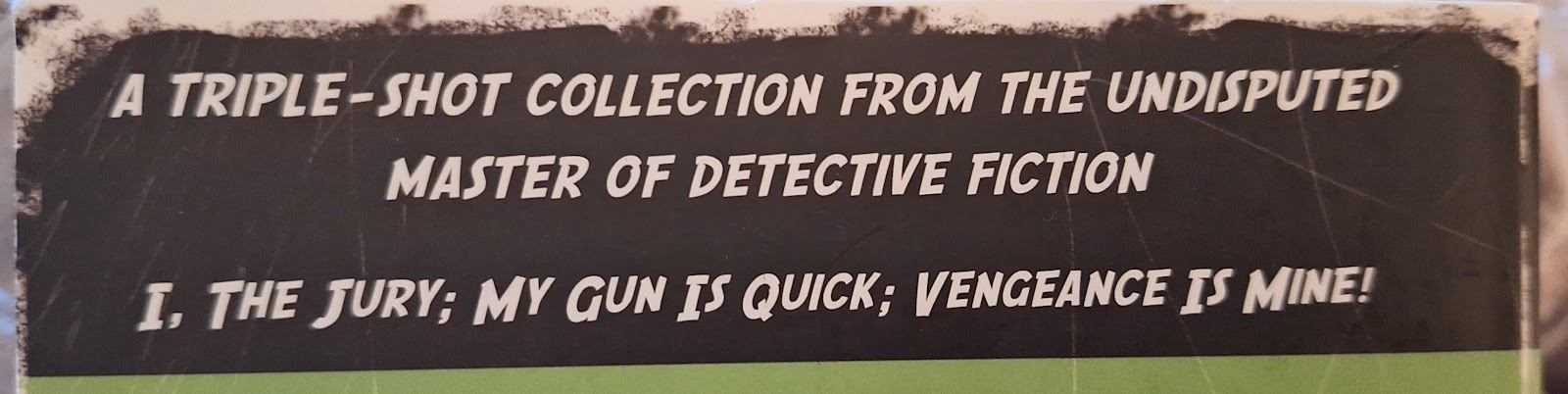
Spillane was a master. Not having read any Mike Hammers before, I had a vague notion of plots and preoccupations, and was entirely hooked from the opening pages of I, The Jury onwards. Once started, that foot hit the pedal and it was easy to roar through all three books in about the same number of days. 

These are the first of the Mike Hammer titles, and one gets a feel for the style quite quickly. Solipsistic and simple from the titles in, it's sex-and-death-wish fulfilment with the kicker that no one gets their wishes fulfilled adequately, least of all the first person who rages his way through the tales without a damn given. 
 
One can correctly predict the deaths of most of the characters, mainly broads and hoods, by dint of the fact that literally everyone dies except Hammer, Pat Chambers (his NYPD foil) and Velda (the smokin' hot, also tough-as-lacquered-nails secretary). 
 
Sex and violence, Spillane reasoned, were in combination irresistible, so, well, here you go. There are intriguing contextual ideas of post-war nihilism and self-abuse to consider, but these are not ideas explored in the texts so much as set on fire then stubbed drunkenly with angry fingers into ashtray shreds. It's as unsophisticated and cartoonish as a character called Mike Hammer would suggest. I lined up those triple shots and drank them down in greedy gulps.

Saturday, September 16, 2023

Hamster Dam

 Hamster Dam - Quentin S. Crisp

Unsettling is the word that came to mind when making book diary notes for this one, and the nib was hovering above the page for quite some time. Hamster Dam is quite the perspective shifter. 


In the book, Hamster Dam is a sort of Gordon Murray/Oliver Postgate kids' TV series from the 1960s or 1970s, set in a community of anthropomorphic hamsters. Or it is according to the memories of Gary, who is taking leave of absence from psychiatric work. His story is narrated by Brian, a colleague and case worker, and he seems uncertain if Hamster Dam ever existed in reality, and, increasingly, what reality even means for Gary, and him, and everyone else.

The writing has multiple hilarious (to me) moments that leaven a weird horror/science tone. There's nothing like a finely-timed bit of whimsy to take the sourer edges off a sober and fairly intense gaze at modern life. The narrator's uncertainty also provokes a constant sense of discomfort about how events might unfold. 

So, yeah, unsettling.

I don't know much about Quentin S. Crisp other than what I've gleaned from various interviews that have popped up with him, including this super effort from the Kulchur Kat blog, and the other bits and pieces of his work that I've scoured dutifully since reading Hamster Dam and being mighty impressed with it. He's definitely now one of those writers where I'll be 'just getting their stuff'.

Hamster Dam is also among the books that tilted me and a fellow tomehound into doing a podcast, watch this space. Crisp and Hamster Dam will almost certainly feature in the inaugural episode.

Friday, September 08, 2023

Do Humankind's Best Days Lie Ahead?

 Do Humankind's Best Days Lie Ahead?

Steven Pinker, Matt Ridley, Alain de Botton, Malcolm Gladwell

We demand rigidly defined areas of doubt and uncertainty!
An almost definitionally shallow sixth form debate level exploration of a feeble motion. This transcript from 2015 presents four riff-heavy bigwigs trading sententious barbs, book-ended by a self-important introduction and reflection sections that add nothing.  

The book is a particular snapshot of a particular moment in time where "71% of people view progress as a continuing thing". Such vague  optimism seems particularly anachronistic in 2023. 

I think I might have enjoyed this more if John Gray and Thomas Ligotti had participated.
 

Friday, September 01, 2023

The Night Clock

The Night Clock

Paul Meloy

 Another book picked up at a library sale. I liked the look of it. It seemed to fit in with other stuff I'd been reading or had on the pile. 

tick tock tick tock tick tock tick Unsettling from the opening, the horror/sci-fi of The Night Clock presents psychological dreamscapes jostling with grimy urban sink estates. Escape hatches between the two shift and clatter. It has several memorable characters and set pieces: the bit where a mobility scooter gets a diabolical chop shop makeover worked especially well. Also, Meloy does a fine line in dry dialogue.

With cosmic automachy, psychopomps and an uber-villain known only as the Junction Creature, it's got a lot of mass beneath the main narrative. This is to its detriment on occasion for me: a fair few "the what now?" moments with back stories, parallel mythologies and new characters. Sometimes it seemed like it was part of a greater whole, but in a kind of sketch-like, unfinished way, where the ideas might have suited a more leisurely unfolding. I can see it working as part of a comic series, for example - it reminded me of something from Vertigo I might have devoured.

Having said that, the dislocated and weird fragmentation aspects are part of the appeal. They suit the dream themes and ideas of fractal mirrorball otherwhens behind the fabric of what we call reality.

Definitely a thumbs up from me, though a volume that has now moved on from the stack.


Friday, August 25, 2023

...and it's goodnight from him

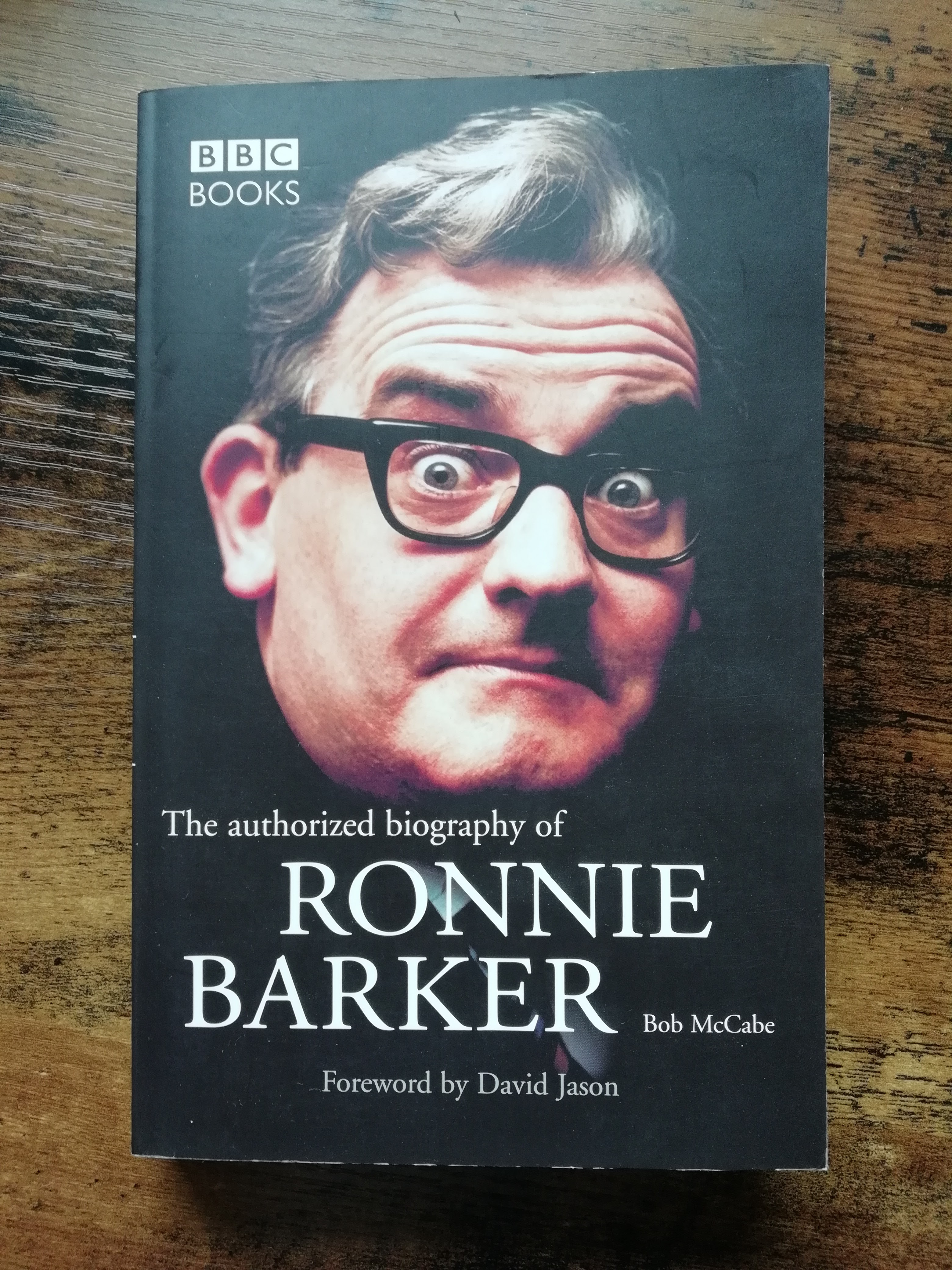
The Authorised Biography of Ronnie Barker
Bob McCabe (2005)

Ronnie Barker was an actor who made the step into 1950s radio, and then 1960s TV performance, specifically mostly comic roles in popular shows like The Navy Lark and The Frost Report. He then became a bit of a legendary character actor across various mostly hugely successful series, including Porridge, Open All Hours, and the at-one-time seemingly-inescapable sketch show The Two Ronnies

He was also a prolific writer, often selling sketches to the shows he was in without the production teams being aware, which is pretty sneakily cool. 

 As to the book, I found this in a charity shop. As a biography, it's not in the slightest bit "warts 'n' all", with a focus on Ronnie Barker's professional life. As McCabe points out in his notes, this was apparently a precondition of Barker's cooperation, perhaps understandably, given Barker's lifelong aversion to personal celebrity, as well as some family laundry he did not wish to air any further than it already had been. 

It's quite vanilla, in many respects, then, and the BBC Books imprint does give it a sort of, "well done, thou good and faithful servant to the Beeb" air. 

However, it has some genuinely interesting insights on theatre, 1950s radio, 1960s-80s TV, ye Ronns, of course, and Barker's writing ideals.

One thing I Did Not Know was that the Ronnies made their long-running shows in advance, dumping any sketches that flopped and "recording their entire series before any of it was broadcast so they could edit and arrange each week's show to make it as strong as it could be". 

In the days of entire seasons of shows being buffed to a high sheen to "drop" in a one-er on Netflix, this is perhaps nothing so amazing, but in 1970s BBC terms, it must have been quite revolutionary. This, with comparable nuggets in the book, reveals a quietly experimental spirit at odds with a cosy reputation, and keen critical eyes behind the famous spectacle frames. 

(The biography was originally published in 1999, then reprinted in 2005 after Barker passed - I read this version in March 2023.)

Friday, August 18, 2023

Beastly


 Beast  - Paul Kingsnorth

Having read a lot about Kingsnorth's writing, getting approving nod from various directions, I was pleased to pick this up in a library sale for a pound or something. 

When it came to it, I was underwhelmed. It seemed a pretty obvious journey of midlife crisis, dressed up with some haunted landscape psychodrama. Completely unsympathetic narrator wandering the flanks of a dark mountain looking for their anima. A "Northern Lights" inversion for ageing fans of Morrissey. 

After the first 20 pages or so I pretty much skim read it, yawning like a big cat. 

Friday, August 11, 2023

Storyland

 Storyland - Amy Jeffs

While on a pile, this was a library book I picked up and whizzed through enthused in a couple of days. Myths and legends of Britain re-told, plus lino cut art - just my jam at this moment. 

The book pieces together a sequence of tales from antiquity for "A New Mythology of Britain". It takes special care to note the political expediency embedded in mythic traditions. 

Jeffs was particularly adept at representing the ways in which each story, complete in itself, was interpolated and adapted by people (rulers) into succeeding myths, self-forming into a coherent sequence creating their own truths. The journey of the artist-author, explored in part in the intro etc,  was also of great interest.

One of those volumes where I immediately start scouring abebooks for the hardback version...


Friday, July 28, 2023

Project Attempted Deck Clearance

A few years ago the loft looked like this:

motivating an enthusiasm for riddance


14 - FOURTEEN - boxes of books, as detailed on t'other blog, with five full sets of shelves downstairs. 

Clingy! And unfathomable now. I mean, we've moved house, actually AND figuratively. 

Them boxes is well gone. Now, after reading, books are either integrated into the shelves or moved on with gratitude (cf Marie Kondo etc).

Still, after quite a sea change, and although engaged in a quite modish regimen of micropiling, there remain, nonetheless, quite a few piles of books. 

So in an attempt to accelerate this particular reader, and to inaugurate this blog recommencement, I'm working through a strict regimen of No New Books* Until All The Unread Books Are Read.  The great Attempted Deck Clearance Project!

And you can read all about it here! 


*possibly scuppered by deep-seated affection for second-hand books

Wednesday, July 26, 2023

Dust covers

chalkboard. Text: "Feed the Minds. Booksale today."

Hi 

 This is the third recommencement of a blog. It's concerned with books, and words, mainly how they're contained in books, but also how words show up in other places as well. 

 It's a place where I can keep notes on responses to tomes, favourable and not, mine and other people's, as well as general notes on writing that is non-bookular. 

Mainly books, though. It's a blog I've set going previously, then promptly forgot about in the busyness of keeping up different interests. So, this time, the dust covers are intended to stay off the furniture. 

 THIS TIME! I tells ya...